
It is understandable that different people have different preference in terms of 4A0-112 study guide. Taking this into consideration, and in order to cater to the different requirements of people from different countries in the international market, we have prepared three kinds of versions of our 4A0-112 Preparation questions in this website, namely, PDF version, online engine and software version, and you can choose any one version of 4A0-112 exam questions as you like.
Nokia 4A0-112 certification exam is an excellent opportunity for network professionals to validate their skills and knowledge in the IS-IS routing protocol and its various features. Nokia IS-IS Routing Protocol certification demonstrates the candidates' ability to work with Nokia service routers and their proficiency in configuring, implementing, and troubleshooting the IS-IS protocol. The Nokia IS-IS Routing Protocol certification is recognized worldwide and is highly valued by employers, making it a valuable investment for network professionals looking to advance their careers.
Nokia 4A0-112 Exam covers a wide range of topics related to IS-IS, including the protocol's operation, design considerations, and implementation best practices. Candidates are expected to have a deep understanding of IS-IS's routing principles, including its use of link-state advertisements (LSAs) and the differences between the Level 1 and Level 2 routing domains. They should also be familiar with Nokia's implementation of IS-IS, including the configuration of IS-IS on Nokia routers, the use of IS-IS metrics, and the implementation of IS-IS features such as route leaking and summarization.
Our 4A0-112 training materials have been honored as the panacea for the candidates for the exam since all of the contents in the 4A0-112 guide materials are the essences of the exam. There are detailed explanations for some difficult questions in our 4A0-112 exam practice. Consequently, with the help of our study materials, you can be confident that you will pass the exam and get the related certification as easy as rolling off a log. So what are you waiting for? Just take immediate action to buy our 4A0-112 learning guide!
Nokia 4A0-112 Exam covers topics such as the configuration and operation of Nokia IS-IS Routing Protocol, IS-IS link-state database concepts, route selection criteria, and IS-IS-related troubleshooting procedures. It also covers the different types of IS-IS messages that are exchanged between routers and how they are used to build and maintain the routing table.
NEW QUESTION # 21
Refer to the exhibit.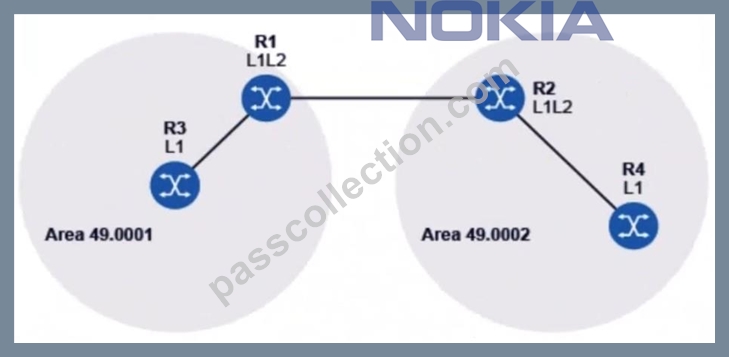
Routers R1 through R4 in the diagram have established IS-IS adjacencies. Router R1 is L1/L2 and is the DIS of its two broadcast interfaces. How many LSPs will it generate?
Answer: B
Explanation:
Router R1 is configured as L1/L2, meaning it is part of both Level 1 and Level 2 IS-IS routing areas. This means R1 will generate two types of LSPs:
Level 1 LSP (for the local area 49.0001) to advertise its local topology to other Level 1 routers.
Level 2 LSP (for the backbone area 49.0002) to advertise the global network topology to Level 2 routers.
R1 also has two broadcast interfaces, and as the Designated Intermediate System (DIS) on these interfaces, it will generate an LSP for each interface (one per broadcast link).
This results in three total LSPs:
A Level 1 LSP for the local area (49.0001).
A Level 2 LSP for the backbone area (49.0002).
An LSP for each of the two broadcast interfaces, which may include interface-related topology information.
NEW QUESTION # 22
Refer to the exhibit.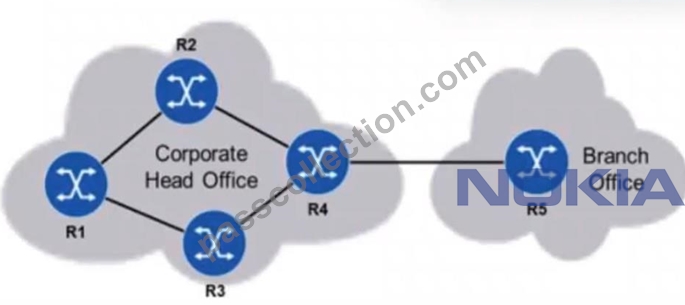
Static routing is to be used in a network between a corporate head office and a branch office. The head office has many connected subnetworks, whereas the branch office has one subnetwork and a single connection to the head office. Which of the following is the most likely configuration on the head office and branch office routers?
Answer: D
Explanation:
The head office has many connected subnetworks, so it will typically have a default route to forward traffic to the branch office (or external networks), since it may not need to define static routes for each branch network.
The branch office, which has only one subnetwork and a single connection to the head office, will have a specific static route to reach the head office subnet or other subnets at the head office, since it only needs to know the specific route to reach the head office's network.
NEW QUESTION # 23
A routing domain is using a single-area link-state routing protocol. Which of the following is NOT information that a router can share with other routers in the domain using protocol-specific messages?
Answer: B
Explanation:
In a single-area link-state routing protocol (such as OSPF), routers share specific information about the network topology, not their entire routing table. They exchange link-state advertisements (LSAs) that contain information about their directly connected interfaces and their state, allowing other routers to build a consistent view of the network.
NEW QUESTION # 24
Which of the following is NOT a required configuration step to successfully run IS-IS on a router?
Answer: C
Explanation:
While configuring a reference bandwidth (which is used to calculate link costs) can be useful, it is not strictly required for IS-IS to run. IS-IS uses default bandwidth values to calculate costs, and it can function without explicitly configuring a reference bandwidth.
NEW QUESTION # 25
What do the address resolution protocol (ARP) for IPv4 and the neighbor discovery procedures for IPv6 have in common?
Answer: A
Explanation:
ARP for IPv4 and Neighbor Discovery Protocol (NDP) for IPv6 are both used to map a device's IP address to its MAC address. This is essential for communication within a local network.
ARP is used in IPv4 networks, and NDP performs a similar function in IPv6 networks, ensuring devices can communicate effectively on the same network segment.
NEW QUESTION # 26
......
Valid 4A0-112 Test Labs: https://www.passcollection.com/4A0-112_real-exams.html